
In this study, under a fixed RJB distance given by the EXSIM model, we systematically analyze the correspondence between the finite-fault model (EXSIM) and the equivalent point-source model (SMSIM) in ground motion simulations. Based on regional parameters from California, simulations are conducted for four moment magnitudes ranging from Mw 6.0 to 7.5. Through the equivalent distance model and the method of minimizing spectral residuals, the SMSIM parameters that achieve the best match in response spectra between the two types of models are determined. The results show that under the same set Joyner–Boore distance (RJB), the equivalent RJB value corresponding to the SMSIM simulation that best matches the EXSIM results is not necessarily equal to the RJB value set in EXSIM, especially in the near field where a systematic shift is observed. More importantly, in the near-field region, to match the finite-fault effects of EXSIM using SMSIM, the equivalent depth h obtained is significantly greater than the actual set source depth. This phenomenon indicates that within the point-source framework, to equivalently represent near-field saturation effects and the influence of finite fault spatial extension, an “equivalent depth” larger than the true physical depth must be introduced as compensation. This study quantitatively reveals two key patterns: “equivalent RJB shift” and “equivalent h enhancement,” establishing a parametric matching relationship from the far field to the near field. It provides important conversion criteria and physical insights for the engineering-equivalent application of finite-fault and point-source models in ground motion simulation.
| Published in | American Journal of Civil Engineering (Volume 14, Issue 2) |
| DOI | 10.11648/j.ajce.20261402.15 |
| Page(s) | 95-103 |
| Creative Commons |
This is an Open Access article, distributed under the terms of the Creative Commons Attribution 4.0 International License (http://creativecommons.org/licenses/by/4.0/), which permits unrestricted use, distribution and reproduction in any medium or format, provided the original work is properly cited. |
| Copyright |
Copyright © The Author(s), 2026. Published by Science Publishing Group |
Ground-motion Simulation, Finite-fault Model, Stochastic Point-source Model, California Region, Joyner-Boore Distance
 (1)
(1) Parameter | Value |
|---|---|
Shear-wave velocity | β=3.7km/s |
Density | ρ=2.8g/cm3 |
Quality factor | Q=max (100, 170.3f0.45) |
Site simplification (NEHRP B/C) | Table 4 of Atikinson and Boore (2006) (e.g. [1 0]) Frequnency-amplification pairs delimited by semicolons: 0.0001Hz-1; 0.1Hz-1.07; 0.24Hz-1.15; 0.45Hz-1.24; 0.79Hz-1.39; 1.38Hz-1.67; 1.93Hz-1.88; 2.85Hz-2.08; 4.30Hz-2.2; 6.34Hz-2.31; 12.5Hz-2.41; 21.2Hz-2.45; 33.4Hz-2.47; 82Hz-2.50 |
Kappa factor | κ0=0.025s |
Path duration | Rupture distance-path duration pairs delimited by semicolons: 0km-0s; 7km-2.4s; 45km-8.4s; 125km-10.9s; 175-17.4s; 270km-34.2s. Path duration increases with distance at a rate of 0.156s/km after the last nodal point. |
Magnitude | Focal depth | Stress paramter | Fault length and width |
|---|---|---|---|
6 | 7km | 75.90bar | 14km×7km |
6.5 | 7km | 75.90bar | 29km×10km |
7 | 7.5km | 81.28bar | 60km×13.5km |
7.5 | 9km | 100bar | 120km×18km |
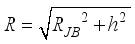 (2)
(2) Magnitude | Far-field limit |
|---|---|
6 | 130km |
6.5 | 150km |
7 | 180km |
7.5 | 220km |
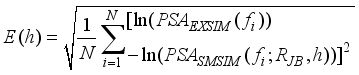 (3)
(3) RJB (EXSIM) | Equivalent RJB (SMSIM) | h\* |
|---|---|---|
2km | 2km | 8km |
5km | 5km | 8km |
10km | 10km | 9km |
20km | 20km | 7km |
30km | 30km | 7km |
40km | 40km | - |
50km | 45km | - |
60km | 50km | - |
70km | 60km | - |
80km | 70km | - |
90km | 80km | - |
100km | 90km | - |
110km | 100km | - |
120km | 110km | - |
130km | 120km | - |
RJB (EXSIM) | Equivalent RJB (SMSIM) | h\* |
|---|---|---|
2km | 2km | 9km |
5km | 5km | 11km |
10km | 10km | 13km |
20km | 20km | 15km |
30km | 30km | 15km |
40km | 40km | 13km |
50km | 50km | - |
60km | 60km | - |
70km | 70km | - |
80km | 80km | - |
90km | 90km | - |
100km | 100km | - |
110km | 110km | - |
120km | 120km | - |
130km | 125km | - |
140km | 130km | - |
150km | 140km | - |
RJB (EXSIM) | Equivalent RJB (SMSIM) | h\* |
|---|---|---|
2km | 2km | 11km |
5km | 5km | 14km |
10km | 10km | 17km |
20km | 20km | 22km |
30km | 30km | 25km |
40km | 40km | 28km |
50km | 50km | 36km |
60km | 70km | - |
70km | 80km | - |
80km | 90km | - |
90km | 100km | - |
100km | 110km | - |
110km | 120km | - |
120km | 130km | - |
130km | 140km | - |
140km | 140km | - |
150km | 150km | - |
160km | 160km | - |
170km | 170km | - |
180km | 180km | - |
RJB (EXSIM) | Equivalent RJB (SMSIM) | h\* |
|---|---|---|
2km | 2km | 13km |
5km | 5km | 18km |
10km | 10km | 23km |
20km | 30km | 19km |
30km | 40km | 23km |
40km | 60km | - |
50km | 80km | - |
60km | 90km | - |
70km | 100km | - |
80km | 110km | - |
90km | 120km | - |
100km | 130km | - |
110km | 140km | - |
120km | 150km | - |
130km | 160km | - |
140km | 170km | - |
150km | 180km | - |
160km | 180km | - |
170km | 190km | - |
180km | 200km | - |
190km | 210km | - |
200km | 220km | - |
210km | 230km | - |
220km | 240km | - |
RJB | Joyner–Boore Distance |
| [1] | Boore, D. M. Stochastic Simulation of High-Frequency Ground Motions Based on Seismological Models of the Radiated Spectra. Bulletin of the Seismological Society of America. 1983, 73(6), 1865-1894. |
| [2] | Boore, D. M. SMSIM: Fortran Programs for Simulating Ground Motions from Earthquakes: Version 2.0—A Revision of OFR 96-80-A. U.S. Geological Survey Open-File Report 96-80-A; 1996. |
| [3] | Beresnev, I. A., Atkinson, G. M. FINSIM: A FORTRAN Program for Simulating Stochastic Acceleration Time Histories from Finite Faults. Seismological Research Letters. 1998, 69(1), 27-32. |
| [4] | Motazedian, D., Atkinson, G. M. Stochastic Finite-Fault Modeling Based on a Dynamic Corner Frequency. Bulletin of the Seismological Society of America. 2005, 95(3), 995-1010. |
| [5] | Mavroeidis, G. P., Papageorgiou, A. S. A Mathematical Representation of Near-Fault Ground Motions. Bulletin of the Seismological Society of America. 2003, 93(3), 1099-1131. |
| [6] | Silva, W. J., Gregor, N., Darragh, R. B. Engineering Ground Motion Hazard Analysis. Proceedings of the International Workshop on Site Response Subjected to Strong Earthquake Motions. 1996, 2, 61-86. |
| [7] | Atkinson, G. M., Silva, W. J. Stochastic Modeling of California Ground Motions. Bulletin of the Seismological Society of America. 2000, 90(2), 255-274. |
| [8] | Boore, D. M. Comparing Stochastic Point-Source and Finite-Source Ground-Motion Simulations: SMSIM and EXSIM. Bulletin of the Seismological Society of America. 2009, 99(6), 3202-3216. |
| [9] | Yenier, E., Atkinson, G. M. Regionally Adjustable Generic Ground-Motion Prediction Equation Based on Equivalent Point-Source Simulations: Application to Central and Eastern North America. Bulletin of the Seismological Society of America. 2015, 105(4), 1989-2009. |
| [10] | Wells, D. L., Coppersmith, K. J. New Empirical Relationships among Magnitude, Rupture Length, Rupture Width, Rupture Area, and Surface Displacement. Bulletin of the Seismological Society of America. 1994, 84(4), 974-1002. |
| [11] | Atkinson, G. M., Boore, D. M. Earthquake Ground-Motion Prediction Equations for Eastern North America. Bulletin of the Seismological Society of America. 2006, 96(6), 2181-2205. |
APA Style
Wang, X., Xie, Z. (2026). Equivalent Mechanism of EXSIM and SMSIM Under Fixed RJB. American Journal of Civil Engineering, 14(2), 95-103. https://doi.org/10.11648/j.ajce.20261402.15
ACS Style
Wang, X.; Xie, Z. Equivalent Mechanism of EXSIM and SMSIM Under Fixed RJB. Am. J. Civ. Eng. 2026, 14(2), 95-103. doi: 10.11648/j.ajce.20261402.15
@article{10.11648/j.ajce.20261402.15,
  author = {Xueting Wang and Zhinan Xie},
  title = {Equivalent Mechanism of EXSIM and SMSIM Under Fixed RJB},
  journal = {American Journal of Civil Engineering},
  volume = {14},
  number = {2},
  pages = {95-103},
  doi = {10.11648/j.ajce.20261402.15},
  url = {https://doi.org/10.11648/j.ajce.20261402.15},
  eprint = {https://article.sciencepublishinggroup.com/pdf/10.11648.j.ajce.20261402.15},
  abstract = {In this study, under a fixed RJB distance given by the EXSIM model, we systematically analyze the correspondence between the finite-fault model (EXSIM) and the equivalent point-source model (SMSIM) in ground motion simulations. Based on regional parameters from California, simulations are conducted for four moment magnitudes ranging from Mw 6.0 to 7.5. Through the equivalent distance model and the method of minimizing spectral residuals, the SMSIM parameters that achieve the best match in response spectra between the two types of models are determined. The results show that under the same set Joyner–Boore distance (RJB), the equivalent RJB value corresponding to the SMSIM simulation that best matches the EXSIM results is not necessarily equal to the RJB value set in EXSIM, especially in the near field where a systematic shift is observed. More importantly, in the near-field region, to match the finite-fault effects of EXSIM using SMSIM, the equivalent depth h obtained is significantly greater than the actual set source depth. This phenomenon indicates that within the point-source framework, to equivalently represent near-field saturation effects and the influence of finite fault spatial extension, an “equivalent depth” larger than the true physical depth must be introduced as compensation. This study quantitatively reveals two key patterns: “equivalent RJB shift” and “equivalent h enhancement,” establishing a parametric matching relationship from the far field to the near field. It provides important conversion criteria and physical insights for the engineering-equivalent application of finite-fault and point-source models in ground motion simulation.},
 year = {2026}
}
TY  - JOUR
T1  - Equivalent Mechanism of EXSIM and SMSIM Under Fixed RJB
AU  - Xueting Wang
AU  - Zhinan Xie
Y1  - 2026/03/31
PY  - 2026
N1  - https://doi.org/10.11648/j.ajce.20261402.15
DO  - 10.11648/j.ajce.20261402.15
T2  - American Journal of Civil Engineering
JF  - American Journal of Civil Engineering
JO  - American Journal of Civil Engineering
SP  - 95
EP  - 103
PB  - Science Publishing Group
SN  - 2330-8737
UR  - https://doi.org/10.11648/j.ajce.20261402.15
AB  - In this study, under a fixed RJB distance given by the EXSIM model, we systematically analyze the correspondence between the finite-fault model (EXSIM) and the equivalent point-source model (SMSIM) in ground motion simulations. Based on regional parameters from California, simulations are conducted for four moment magnitudes ranging from Mw 6.0 to 7.5. Through the equivalent distance model and the method of minimizing spectral residuals, the SMSIM parameters that achieve the best match in response spectra between the two types of models are determined. The results show that under the same set Joyner–Boore distance (RJB), the equivalent RJB value corresponding to the SMSIM simulation that best matches the EXSIM results is not necessarily equal to the RJB value set in EXSIM, especially in the near field where a systematic shift is observed. More importantly, in the near-field region, to match the finite-fault effects of EXSIM using SMSIM, the equivalent depth h obtained is significantly greater than the actual set source depth. This phenomenon indicates that within the point-source framework, to equivalently represent near-field saturation effects and the influence of finite fault spatial extension, an “equivalent depth” larger than the true physical depth must be introduced as compensation. This study quantitatively reveals two key patterns: “equivalent RJB shift” and “equivalent h enhancement,” establishing a parametric matching relationship from the far field to the near field. It provides important conversion criteria and physical insights for the engineering-equivalent application of finite-fault and point-source models in ground motion simulation.
VL  - 14
IS  - 2
ER  -
Civil Engineering, Institute of Engineering Mechanics, China Earthquake Administration, Harbin, China
Civil Engineering, Institute of Engineering Mechanics, China Earthquake Administration, Harbin, China
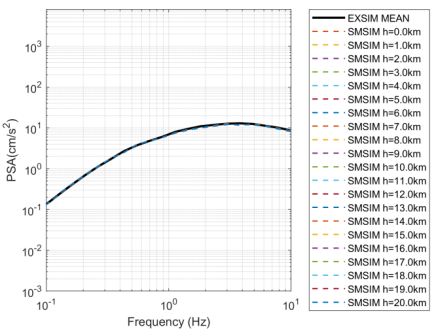
Figure 1. Comparison of simulation results between EXSIM at RJB = 130 km and SMSIM at RJB = 120 km for different values of h, given Mw = 6.0.
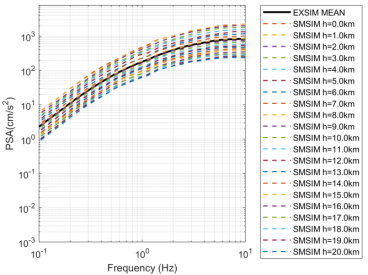
Figure 2. Simulation results of EXSIM at RJB = 5 km compared with those of SMSIM at RJB = 5 km under different equivalent burial depths h, given Mw = 6.0.
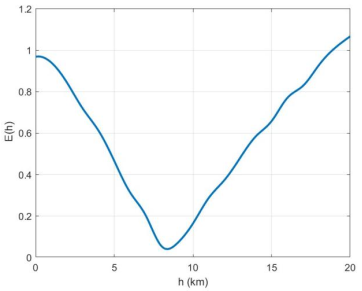
Figure 3. Relationship between residual error and equivalent burial depth h when both EXSIM and SMSIM are set at RJB = 5 km, given Mw = 6.0.



 Share This Article
 Twitter
 Linked In
 Facebook
 Copy
Copy Download